The Vertical Farming Reckoning
An evidence-based analysis of economics, technology, policy, and the practical limits of vertical farming for modern food production
Ammad Abbas Khan, PhD
Introduction
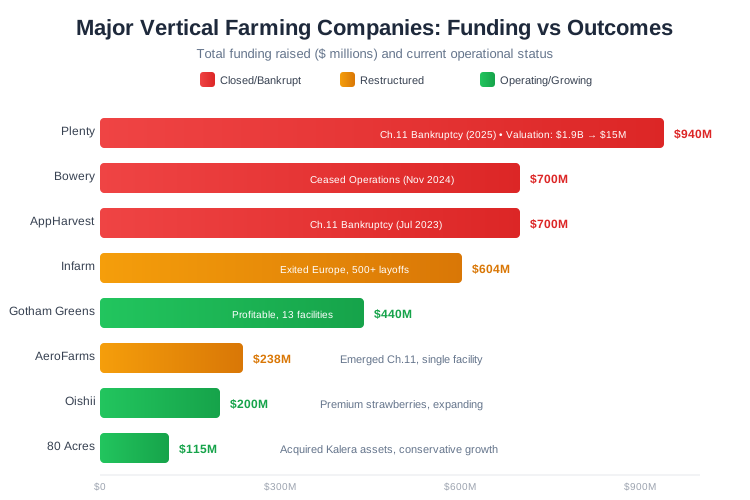
In November 2024, Bowery Farming—a major U.S. indoor agriculture operator that had raised more than $700 million from institutional investors—announced it would cease operations immediately. The company had built commercial facilities, established retail partnerships, and positioned itself at the center of the fast-growing vertical farming sector.
Bowery's shutdown followed a string of high-profile retrenchments across the industry—AeroFarms and AppHarvest entered bankruptcy in 2023, Infarm substantially scaled back European operations, and several other operators reduced or shuttered commercial activity. In March 2025, Plenty, a large indoor grower that invested heavily in commercial-scale berry production, filed for Chapter 11 protection.
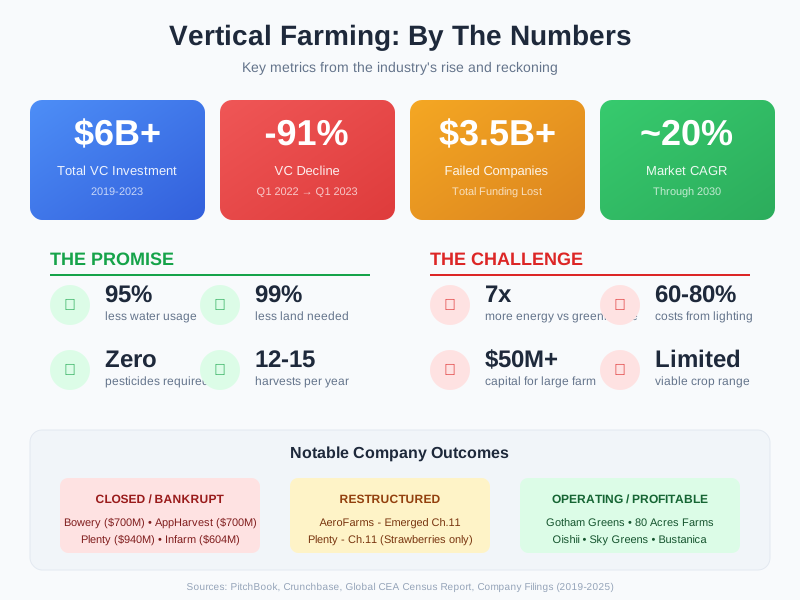
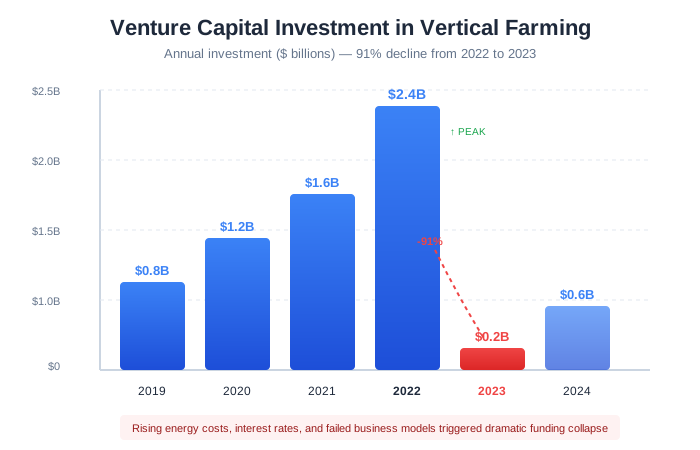
These developments reflect a broader recalibration: after more than $6 billion flowed into indoor and vertical farms between 2019 and 2023, venture capital funding declined sharply in 2023. The sector is moving from an early, growth-focused phase toward one driven by unit economics, site selection, and technological pragmatism.
This article evaluates vertical farming—growing crops in vertically stacked layers within controlled environment systems—by examining its technical advantages, the economic failures that have emerged at scale, and the practical models that demonstrate viability. It presents a concise roadmap for stakeholders: the promise of vertical farms; the investment history and market corrections; the operational challenges; examples of working business models; and the technology and policy developments likely to shape the next phase of the industry.
The Promise of Vertical Farming
Vertical farming uses vertically stacked layers and controlled environment systems to produce crops indoors. The approach aims to decouple food production from weather, seasons, and geography by combining hydroponic or aeroponic systems, artificial lighting, and precise climate control. Proponents highlight several measurable advantages that explain why investors and operators focused on vertical farms in the past decade.
Water and Land Efficiency
Conventional agriculture accounts for the majority of global freshwater withdrawals; closed-loop hydroponic and aeroponic systems in vertical farms recirculate nutrient solutions and can reduce water use dramatically compared with field irrigation. Reported reductions range from roughly 90% to 98% depending on crop and system configuration. Large commercial facilities operating in water-constrained regions document substantial savings—for example, a major UAE facility reports annual water savings in the hundreds of millions of liters while producing over one million kilograms of leafy greens. These reductions make vertical farms particularly attractive in arid or water-stressed locations.
Land use is another clear benefit. By stacking production vertically, indoor systems can multiply output per unit footprint: most operational analyses show yields per acre that are several times higher than conventional farms, and year-round production can increase annual throughput further. In dense urban settings or small island states, this space efficiency enables local production that would be impossible with traditional farming alone.
Year-Round Production and Reduced Food Miles
Controlled environments enable multiple harvests per year for fast-growing crops. Leafy greens, for example, can be harvested a dozen or more times annually in optimized facilities, compared with two to three field harvests in temperate outdoor systems. Co-locating production near metropolitan demand centers shortens supply chains and can reduce food miles substantially; perishable produce that typically travels long distances can instead be delivered within hours of harvest, improving freshness and cutting transportation emissions.
Pesticide-Free Production and Food Safety
Sealed indoor systems dramatically reduce exposure to pests and diseases, allowing many operators to eliminate routine pesticide and herbicide use for crops such as leafy greens, herbs, and microgreens. This characteristic improves food-safety control because environmental variables are monitored and adjusted continuously; operators can document traceability from seed to shelf. For consumers prioritizing low-chemical produce, this is a principal value proposition of vertical farming.
Climate Resilience and Supply Reliability
Controlled environment agriculture offers production stability when outdoor production is disrupted by extreme weather, pests, or disease. Indoor production can maintain consistent output through droughts, floods, or localized crop failures, making vertical farms a strategic option for food security in regions reliant on imports. For water-scarce or climatically extreme areas, vertical farms function as infrastructure that complements traditional agriculture rather than replacing it.
Market Growth and Investment History
The vertical farming sector has attracted substantial capital and rapid operational expansion over the past decade, even as definitions vary between strict "vertical farms" and the broader category of controlled environment agriculture (CEA). Market-size estimates for 2024 differ by source—ranging from the mid-single billions to low double-digit billions—reflecting different scopes and methodologies. Forecasts project continued growth through the 2030s, driven by urbanization, demand for local food production, and investments in production systems, though projected ranges are wide and dependent on which crops and business models scale commercially.
The Investment Boom: 2019–2022
Low interest rates and strong investor interest in climate- and supply-chain-resilient food production drove large venture rounds between 2019 and 2022. Indoor and vertical farms captured a meaningful share of agtech funding in that window, with several companies raising rounds that exceeded typical agtech norms. Notable capital events included multiple nine-figure financings across leafy-greens and specialty-crop operators, and aggregate sector fundraising that reached several billion dollars globally during peak years.
Between 2018 and 2022 the indoor farming sector attracted sizable venture allocations. Several operators raised more than $100 million each, reflecting investor confidence in the combination of technology-led yield improvements and perceived market demand for locally produced food. These rounds funded rapid expansion of production capacity, development of automated production systems, and commercialization efforts aimed at retail and foodservice customers.
The Funding Correction: 2023–Present
Beginning in 2023, capital flows into the sector slowed sharply as interest-rate normalization, macroeconomic uncertainty, and a clearer view of unit economics prompted investor caution. Reported venture funding for indoor farms declined substantially year-on-year in early 2023; subsequent years showed only partial recovery. The aggregate amount raised in 2024 was a fraction of peak-year totals, and large, unconditional growth-stage financings became rare. Fundraising since 2022 has tended to favor operators with disciplined cost structures, clear path to profitability, or infrastructure-style backers rather than pure VC growth plays.
The post-2022 funding environment emphasizes pragmatic capital: strategic corporate investments, project finance for facility builds, and selective growth capital tied to demonstrable margins or premium product strategies. This shift has reshaped deployment timelines and scaled-back speculative expansion plans for many operators.
Geographic Distribution and Market Dynamics
Investment and operations have concentrated where market access, policy support, and site economics align. North America remains a substantial share of activity, driven by retail demand and logistics advantages for co-located production. Europe has significant activity but higher energy costs in some markets have constrained commercial rollout. Asia-Pacific—especially Singapore, Japan, and select Chinese markets—is an accelerating growth region due to limited arable land and strong government support. The Middle East is deploying vertical farms as strategic food-production infrastructure in water-scarce and import-dependent settings.
Key commercial dynamics that determined which operators attracted capital include: electricity costs and availability, proximity to urban demand, chosen crop mix (leafy greens versus higher-value specialty crops), and the chosen operating model (pure vertical stacks versus greenhouse-LED hybrids). Where those factors align, vertical farms can secure offtake agreements and infrastructure-style financing that support sustainable growth.
The Failures and Challenges
Several high-profile vertical farms and indoor agriculture ventures scaled rapidly and then retrenched or failed. These outcomes expose systematic challenges in energy economics, capital intensity, crop selection, and the fit between financial models and operational realities. An objective review of those failures reveals where the technology delivers value and where the economics break down.
Prominent corporate outcomes and lessons
AeroFarms entered Chapter 11 proceedings in mid‑2023 after substantial capital deployment and a public restructuring; post-bankruptcy the business narrowed its footprint to focus on a single facility and core commercial operations. Key lesson: rapid multi-site expansion without demonstrable, repeatable unit economics increases systemic risk.
AppHarvest similarly pursued large-scale greenhouse and indoor production and filed for Chapter 11 in 2023 after significant capital expenditures and operational challenges. Corporate filings identified cash shortfalls and operational stress points. Key lesson: scale requires disciplined site economics and industrial operations management comparable to commodity agriculture.
Infarm significantly reduced European operations and workforce in 2022–2023 as energy prices rose and financial markets tightened. The company consolidated activities and redirected investment toward markets with more favorable energy and policy conditions. Key lesson: electricity price exposure materially alters the competitive position of vertical farms versus outdoor or greenhouse production.
Bowery Farming halted operations in late 2024 after building substantial capacity and securing major retail partnerships. The company’s outcome illustrates how high fixed costs and financing structures can convert operational shortfalls into terminal liquidity events. Key lesson: financing terms and debt levels are as critical as operational performance when assessing farm viability.
Plenty restructured in 2025 to concentrate on a single, higher-margin crop line following a period of broad product experimentation and capital-intensive expansion. Key lesson: niche, premium crops with clear willingness-to-pay can support higher capital intensity than commodity strategies.
Other operators have closed or been restructured; the common threads across these outcomes are predictable: elevated operating and capital costs, sensitivity to energy price shocks, and difficulty competing with field-grown produce on price for broad commodity categories.
Energy intensity and its economic impact
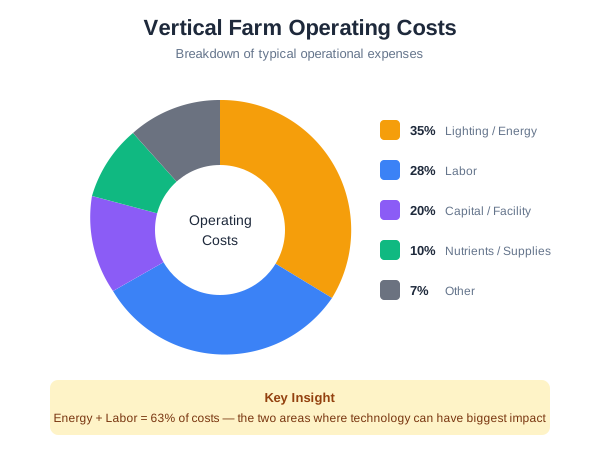
The primary structural disadvantage for fully indoor vertical farms is energy. Artificial lighting and climate control replace free solar energy; lighting commonly represents the largest single energy expense and can account for 60–80% of total electrical consumption. Industry surveys and technical studies report wide ranges for energy intensity—typical values for fully artificially lit systems can be multiples higher than greenhouse operations when measured per kilogram of produce. At commercial electricity prices that exceed competitive thresholds, energy costs alone can render commodity lettuce or similar products unprofitable.
Capital intensity, labor and unit economics
Building vertical farms requires significant upfront investment in infrastructure, lighting, HVAC, shelving or tower systems, and water-recirculation equipment. Capital costs vary by system type, but even modest commercial facilities require multi‑million dollar commitments; large, 'XL' campuses can exceed tens or hundreds of millions. Labor remains material—estimates place labor as a substantial portion of operating expenses even with automation in place. These factors combine to create narrow margins for commodity crops and long payback periods unless the operation secures premium pricing, low energy costs, or strategic offtake agreements.
Crop selection limits and comparative economics
Operational evidence shows vertical farming is economically viable for a constrained set of crops—fast-turnover, high-value items such as leafy greens, herbs, microgreens, and increasingly select berry varieties. Attempts to produce high-tonnage staples indoors encounter steep cost disadvantages because of lighting and space requirements and the physics of photosynthetic conversion. For these crops, outdoor or greenhouse production remains far more cost-effective.
Financial model mismatch with venture capital
The industry's rapid early funding favored growth at scale without consistent demonstration of profitable unit economics. Venture capital models that prioritize rapid scaling and near-term exits are frequently at odds with the capital structure and time horizon required for profitable farming operations. In practice, successful long-term operators have shifted toward discipline: conservative capital deployment, careful site selection prioritizing low-cost electricity and proximity to markets, and financing structures aligned with infrastructure or corporate strategic investors.
Key takeaway: the technical potential of vertical farms is real, but translating that potential into profitable, scalable farms requires rigorous attention to energy sourcing, crop economics, capital structure, and disciplined operations management.
What Actually Works
Despite headline failures, a subset of vertical farms and controlled-environment operations demonstrate commercially viable models. Success is not random: it aligns with specific crop choices, disciplined financial management, favorable site economics (notably low-cost electricity), or strategic positioning where imported produce and water scarcity make local production economically competitive.
Geographic fit and infrastructure-backed models
Vertical farming delivers the clearest economic value where traditional farming is constrained by climate, water, or land. In water-scarce, import-dependent regions, vertically stacked production reduces supply-chain risk and lowers food miles by producing closer to urban demand centers. Large, infrastructure-style owners treating farms as strategic assets—rather than pure VC-backed startups—have deployed facilities as part of corporate or national food-security strategies, improving the prospects for long-term sustainability.
Operational discipline: standardized systems and site economics
Operators that emphasize standardized hydroponic systems, careful site selection, and tight cost control have outperformed peers. Key operational criteria include access to low-cost or contracted electricity, proximity to urban buyers to reduce shipping and spoilage, and process discipline that prioritizes yield consistency and waste reduction. When these fundamentals are in place, farms can achieve reproducible unit economics for targeted crops, particularly leafy greens and herbs.
Premium crops and niche positioning
A proven route to profitability is focusing on high-margin, specialty produce where consumers pay a meaningful premium for quality, consistency, or novelty. Premium berries, specialty herbs, and tailored culinary varieties can absorb higher production costs and justify investment in more complex vertical systems. This premium positioning reduces direct price competition with low-cost, field-grown commodity produce and aligns product strategy with higher-margin foodservice and specialty retail channels.
Hybrid greenhouse and light-supplemented models
Combining sunlight with vertical or multi-tiered layouts in greenhouse environments reduces the energy burden of fully artificially lit farms. These hybrid approaches use LEDs for targeted supplementation and to extend the growing season while leveraging free solar energy for baseline photosynthesis. Where feasible, hybrids deliver lower energy consumption per kilogram and improved economics for a broader set of crops than fully enclosed, electric-lit vertical farms.
Technology and process gains that matter
Incremental improvements in LED efficiency, automation, and nutrient-management systems reduce energy and labor costs but do not eliminate the fundamental physics that make sunlight free. The economic impact of these technologies is real: targeted automation reduces labor and improves consistency; spectral tuning and optimized nutrient regimes raise yields and quality. Crucially, these advances must be deployed as part of a disciplined operating model, not as substitutes for poor site economics or excessive capital spend.
Success factors checklist
Operators and investors evaluating vertical farms should prioritize: (1) Electricity cost and sourcing strategy; (2) Crop selection focused on high-turnover or premium produce; (3) Proximity to buyers to reduce shipping and spoilage; (4) Conservative capital deployment and financing aligned with infrastructure timelines; (5) Technology investments targeted at reducing energy or labor intensity rather than expanding capacity without proof of unit economics.
When these elements are combined—right geography, disciplined farming systems, appropriate crops, and realistic financing—vertical farming can be a profitable complement to traditional agriculture, particularly in urban areas and regions where imports and water scarcity make local production a strategic priority.
What's Next: Technology, Policy, and Market Evolution
The commercial trajectory of vertical farming depends on realistic technological gains, disciplined deployment of systems, and targeted policy support. Several developments can materially improve economics for certain crops and sites, but fundamental constraints remain; the next phase will be characterized by selective adoption rather than universal substitution of field agriculture.
Lighting and energy efficiency gains
Improvements in lighting technology and controls reduce energy per kilogram of output and narrow the gap with greenhouse operations. Modern light sources deliver substantially higher photons-per-watt and allow spectral tuning that increases photosynthetic efficiency for specific crops. These advances can cut lighting energy use by meaningful percentages versus earlier installations, improving operating costs for vertical farms. However, physical limits remain: electricity will not be free sunlight, and energy will continue to be a principal cost driver for fully indoor farms.
Automation, monitoring and AI-driven control
Automation and software reduce labor intensity and improve consistency. Integrated sensor networks, closed-loop nutrient control, and predictive climate management reduce waste and optimize yield per square meter. When paired with autonomous harvesting and sorting, these systems lower ongoing operating costs and improve product quality—shifting some economics in favor of indoor production for targeted crops. These technologies are most effective when deployed to solve clearly identified bottlenecks rather than as open-ended R&D expenditures.
Renewable energy and flexible grid strategies
On-site generation, power purchase agreements, and time-of-use strategies materially affect energy economics. Farms that combine solar arrays, battery storage, or contracted low-cost industrial power reduce exposure to volatile market prices and can schedule high-consumption activities during off-peak hours. Heat-recovery and waste-heat integration further improve overall site efficiency. These approaches make sense where land and capital are available to support renewable installations or where long-term contracts are accessible.
Crop diversification and breeding for indoor systems
The industry is broadening beyond leafy greens into higher-margin crops such as specialty berries, herbs, and niche ingredients where premium pricing offsets higher production costs. Parallel efforts in plant breeding aim to develop cultivars optimized for indoor light spectra, space-constrained growth habits, and flavor or nutritional traits that command a premium. Diversification increases total addressable production and reduces dependence on a single commodity category, but it requires careful economic modeling for each crop.
Policy, public funding and food-security roles
Government programs and public investment can shift the economics for vertical farms where food security or regional resilience is a priority. Grants, infrastructure financing, tax incentives, and urban agriculture zoning lower the effective cost of capital or operating expenses and can justify deployments in strategic locations. Policymakers evaluating support should prioritize projects with clear metrics for local food production, job creation, and demonstrable reductions in supply-chain vulnerability.
What's plausible versus speculative
Plausible near-term outcomes: steady improvements in LED and automation efficiency, wider deployment of hybrid greenhouse-vertical systems, and targeted adoption in water-scarce or import-dependent regions. Speculative or long-horizon outcomes: full replacement of field agriculture for staples, or dramatic exponential reductions in energy costs without concurrent grid and storage improvements. Stakeholders should plan for incremental gains and focus on projects where site economics and crop selection already indicate a path to profitability.
In short, technology can improve vertical farming economics, but success will come from combining technical advances with disciplined finance, realistic crop strategies, and policy frameworks that recognize vertical farms as one component of resilient, modern food systems.
Conclusion: A Realistic Assessment
Vertical farming is a valuable and growing segment of modern food production, but it is not a universal replacement for field agriculture. The physical limits of photosynthesis and the economics of electrically produced light make fully indoor production uneconomic for many staple crops. The recent wave of company failures highlights the difference between technological capability and commercial viability: success depends on matching crop types, site economics, and financing to realistic production systems.
At the same time, vertical farms have demonstrated measurable advances: reductions in water use, high yields per unit area, pesticide-free production for specific crops, and reliable year‑round supply for urban consumers. The capital deployed across the sector accelerated LED development, automation, and supply‑chain integration that now benefit surviving operators and new entrants. Those technical gains matter when combined with prudent business design.
Priority actions for stakeholders:
1. Geographic fit: Deploy vertical farms where water scarcity, limited arable land, or import dependence make local production economically preferable to long-distance shipping.
2. Premium and focused crop strategies: Prioritize high-value, fast-turnover crops—leafy greens, herbs, and select berries—where price premiums or foodservice channels support higher production costs.
3. Financial discipline: Structure projects with conservative capital deployment, realistic unit-economics models, and financing aligned to the multi-year timelines characteristic of farming infrastructure.
4. Alternative financing and partnerships: Favor infrastructure finance, strategic corporate ownership, and real‑asset partnerships over purely growth‑oriented VC capital for capital‑intensive farms.
5. Technological pragmatism: Apply LEDs, automation, and breeding programs to reduce energy and labor intensity where those investments demonstrably improve margins; employ hybrid greenhouse-vertical systems to leverage sunlight when possible.
Climate change will continue to raise the costs and variability of outdoor agriculture. In that context, controlled-environment production and vertical farms become comparatively more attractive in specific geographies and for particular crops. The industry that survives the recent correction will be more disciplined, economically focused, and practical in its deployment of vertical farms as part of a diversified, resilient food-production system.
For investors, operators, and policymakers, the guiding question is not whether vertical farming can grow food—it can—but whether it can grow food profitably in the intended context. When crop selection, site economics, technology, and financing align, the answer is increasingly affirmative.